Wire up a new sensor and you’ll almost always see the same signal coming out of it. Not a nice round 0 to 10 volts, but a 4-20 mA current loop. The first time you run into it, it looks like a strange way to do things. Then you watch a voltage signal fall apart out on a plant floor and it starts to make a lot of sense.
Here’s why the current loop wins.
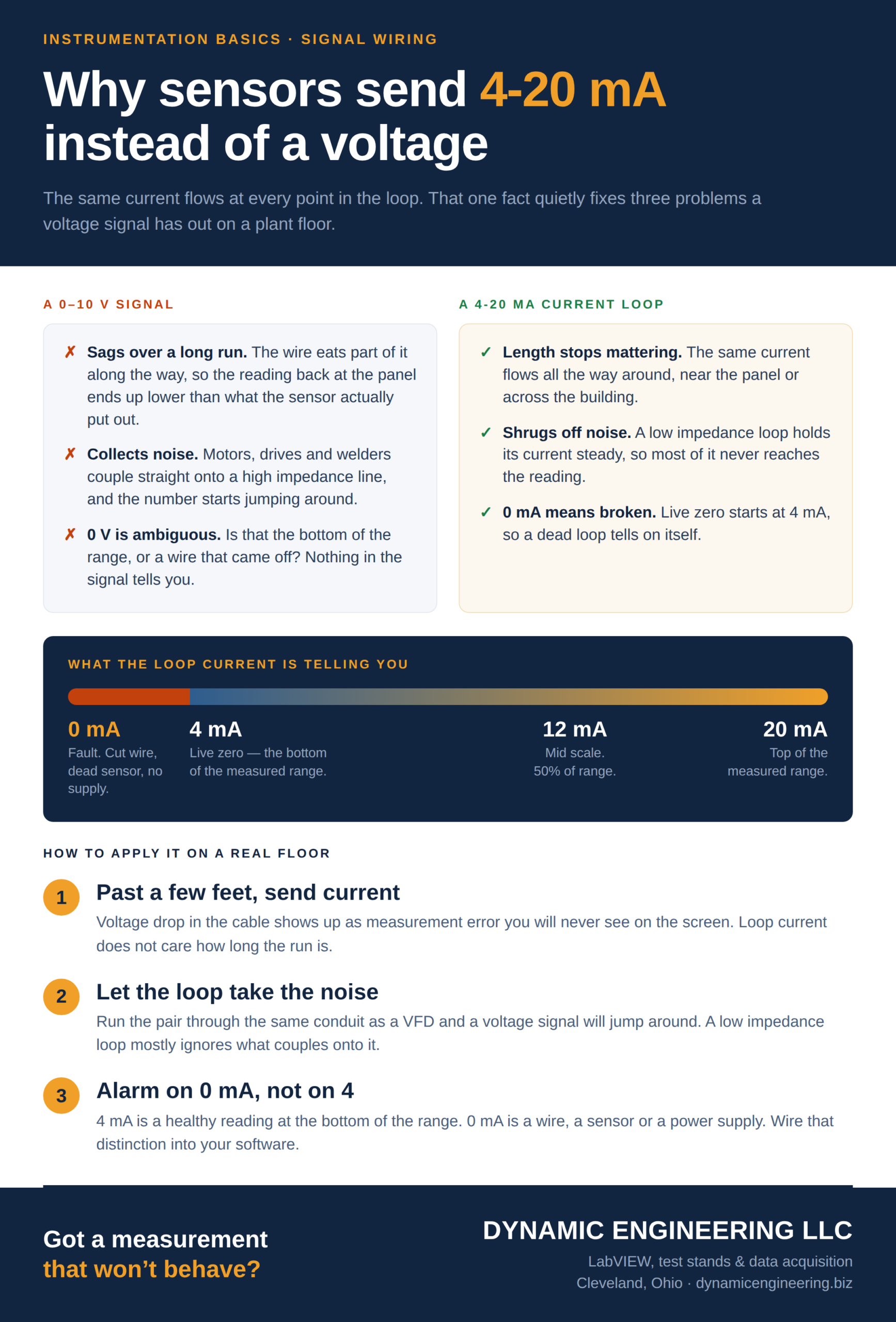
Voltage fades over a long run, a 4-20 mA current loop doesn’t
Run a voltage down a few hundred feet of cable and the wire itself steals a little of it along the way. So the reading back at the panel ends up lower than what the sensor actually put out. A current loop doesn’t have that problem. The same current flows all the way around the loop no matter how long the wire is. A transmitter way out on the far side of the building reads the same as one sitting right next to you.
Noise has a harder time getting in
Motors, drives and welders throw a lot of electrical noise around, and that noise couples pretty easily onto a voltage line. A current loop runs at low impedance and holds its current steady, so most of that noise never shows up in your reading. On a busy floor that’s often the difference between a number you trust and one that jumps all over the place.
Zero isn’t really zero
The scale starts at 4 mA instead of 0, and that turns out to be handy. If you ever read 0 mA, it doesn’t mean the bottom of the range. It means something broke. A cut wire, a dead sensor, a loose connection. The signal basically tells on itself.
So for anything past a few feet on a noisy floor, a 4-20 mA current loop is usually the safe bet. Picking and wiring sensor signals the right way is part of every system we build at Dynamic Engineering LLC here in the Cleveland area. Got a measurement that won’t behave? Get in touch or read more about Joseph Zarycki.
By Joseph “Joe” Zarycki, Dynamic Engineering LLC