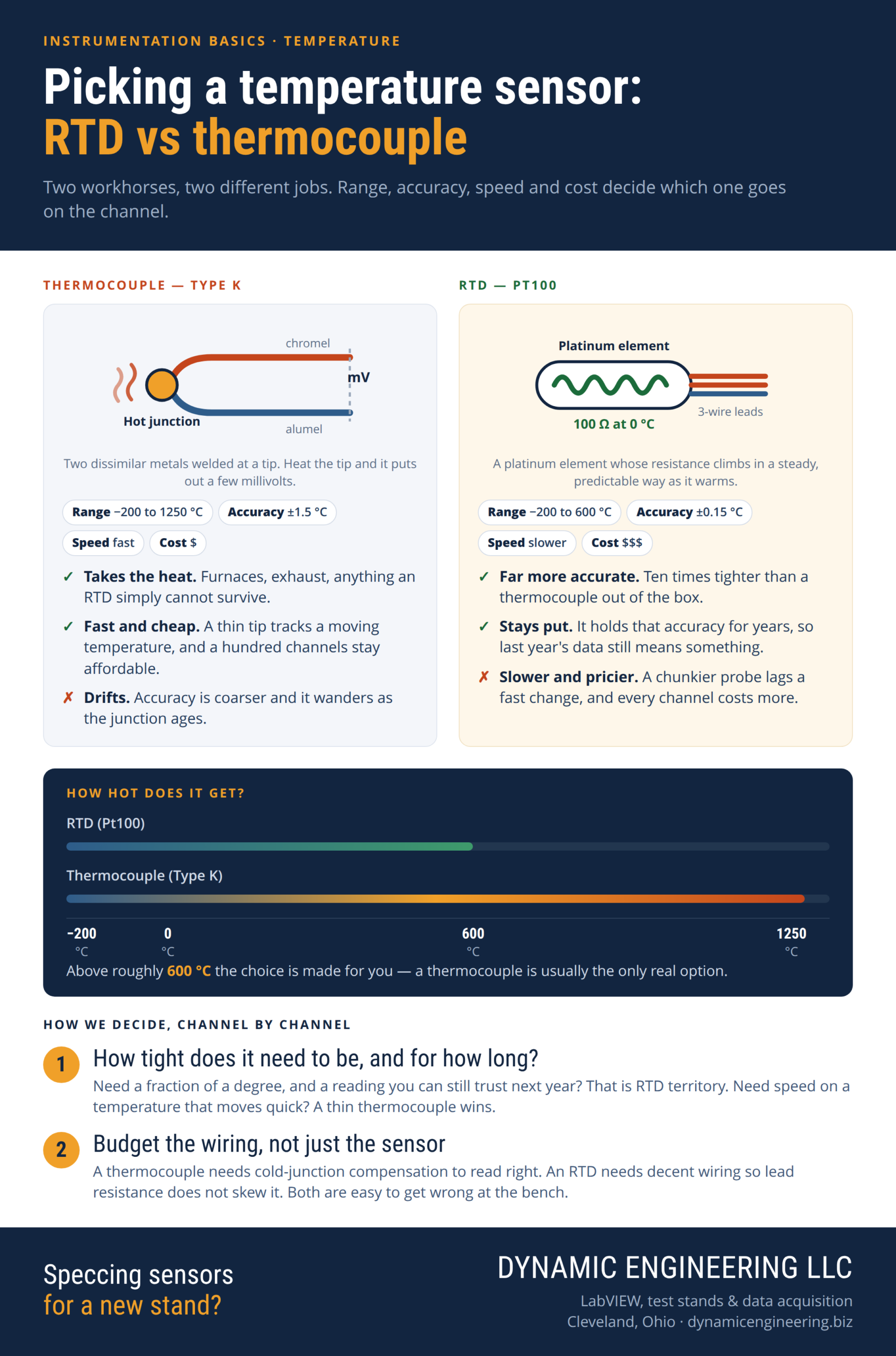
Pick the wrong temperature sensor and you’ll fight it for the life of the machine. Here’s the short version of how we decide RTD vs thermocouple, the two workhorses of temperature measurement.
What each one actually is
A thermocouple is two different metals joined at a tip. Heat that tip and it puts out a tiny voltage. A Type K reads from way below zero up past 2000 °F, and it’s cheap and quick. That’s why you find them on furnaces, exhaust, anything hot or fast moving.
An RTD is a different animal. It’s usually a platinum element, and its resistance climbs in a nice steady way as it warms up. The common one is a Pt100, 100 ohms at 0 °C. It won’t go as hot as a thermocouple, but it’s far more accurate and it holds that accuracy for years.
How we pick: RTD vs thermocouple
It comes down to a few questions. How hot does it get? Above roughly 600 °C a thermocouple is often your only real option. How tight does the reading need to be? For a fraction of a degree, and readings you can still trust next year, we reach for an RTD. How fast does it change? A thin thermocouple beats a chunkier RTD when the temperature moves quick. And what’s the budget across a hundred channels? Thermocouples add up a lot cheaper.
One thing people forget. A thermocouple needs cold-junction compensation to read right, and an RTD needs decent wiring so lead resistance doesn’t skew it. Both are easy to get wrong at the bench.
Get it right the first time
Temperature is half the battle on most test stands we build. If you’re speccing sensors for a new stand, still weighing RTD vs thermocouple, or chasing a reading that drifts, our team can help. Reach out to Dynamic Engineering in the Cleveland area and talk it over with an instrumentation engineer who does this every day.