By Joseph “Joe” Zarycki
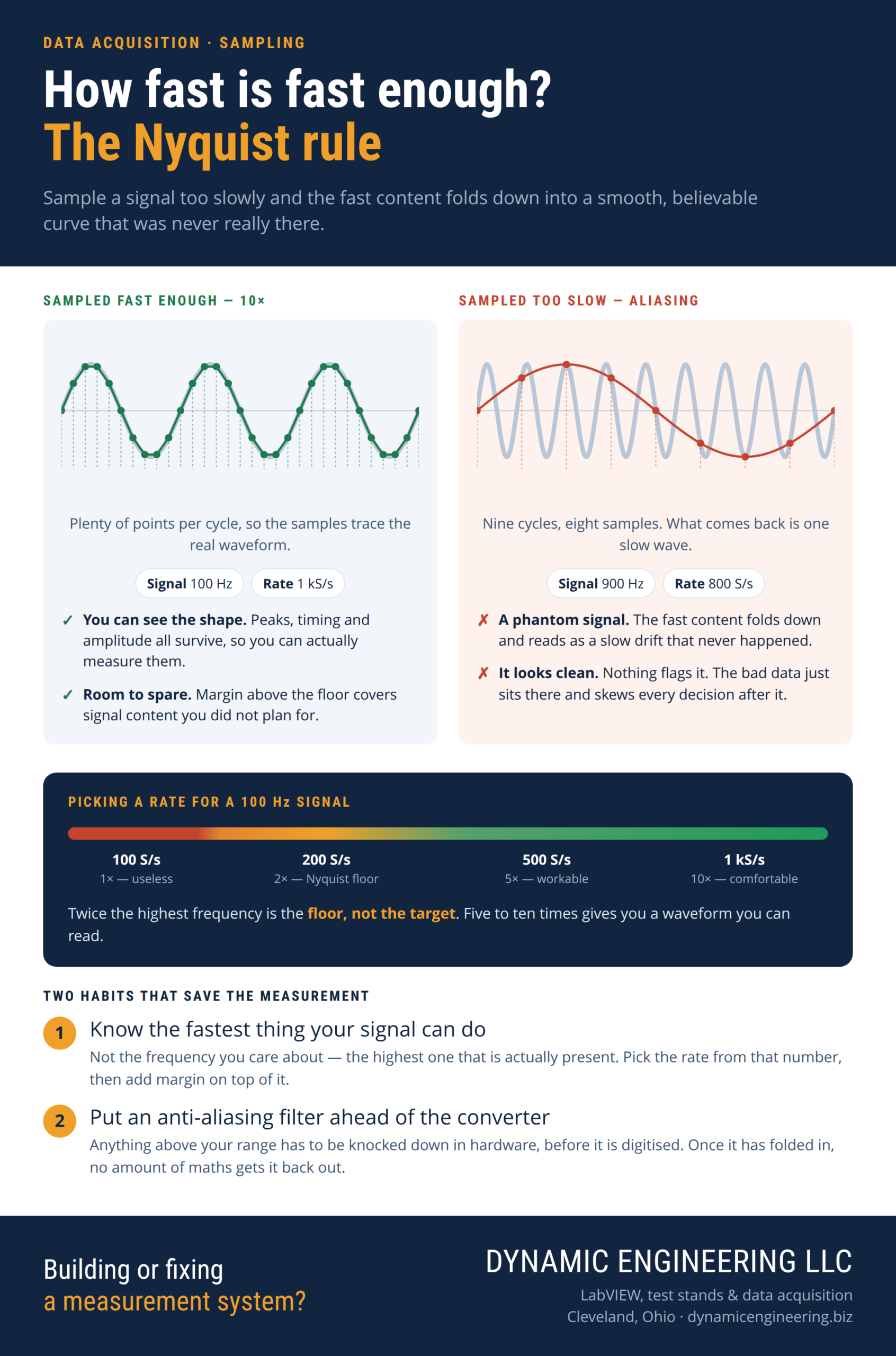
Here’s a question that trips up a lot of good measurements. How fast do you need to sample a signal to capture it right? The Nyquist rule has the answer. Sample too slow and your data lies to you. It looks clean on the screen. It’s just wrong.
The Nyquist rule in plain terms
The Nyquist rule is simple. You have to sample at least twice as fast as the highest frequency in your signal. If you want to see a 100 Hz vibration, you need more than 200 samples per second. That 2x number is the Nyquist rate, and it’s the floor, not the target.
In the real world we push well past 2x. Sampling at five or ten times the signal frequency gives you a waveform you can actually read and measure, not just a number that technically satisfies the math.
What happens when you go too slow
Skip the Nyquist rule and you get aliasing. A fast signal shows up as a slow one that was never really there. Think of a fan blade that looks like it’s crawling backward under a strobe light. Same idea. Your DAQ catches the wobble at the wrong moments and hands you a smooth, slow curve that looks believable.
That’s the dangerous part. A missed spike or a phantom drift doesn’t announce itself. It just sits in your data and skews every decision after it. On a test stand chasing an intermittent fault, that can send you looking in the wrong place for days.
A quick habit that saves you
Know the fastest thing your signal can do before you pick a rate. Then give yourself margin above 2x, and put an anti-aliasing filter ahead of the converter so anything above your range gets knocked down before it can fold back in.
Getting sampling and filtering right is the difference between data you can trust and data that fools you. If you’re building or fixing a measurement system in the Cleveland area, our team at Dynamic Engineering can help you spec it right, and you can learn more about us or reach out through our contact page.