
You wire up a clean sensor, a solid DAQ, and the signal still has a slow hum riding on it. Nine times out of ten the culprit is a ground loop. Here’s what that is and how to shut it down.
What a ground loop actually is
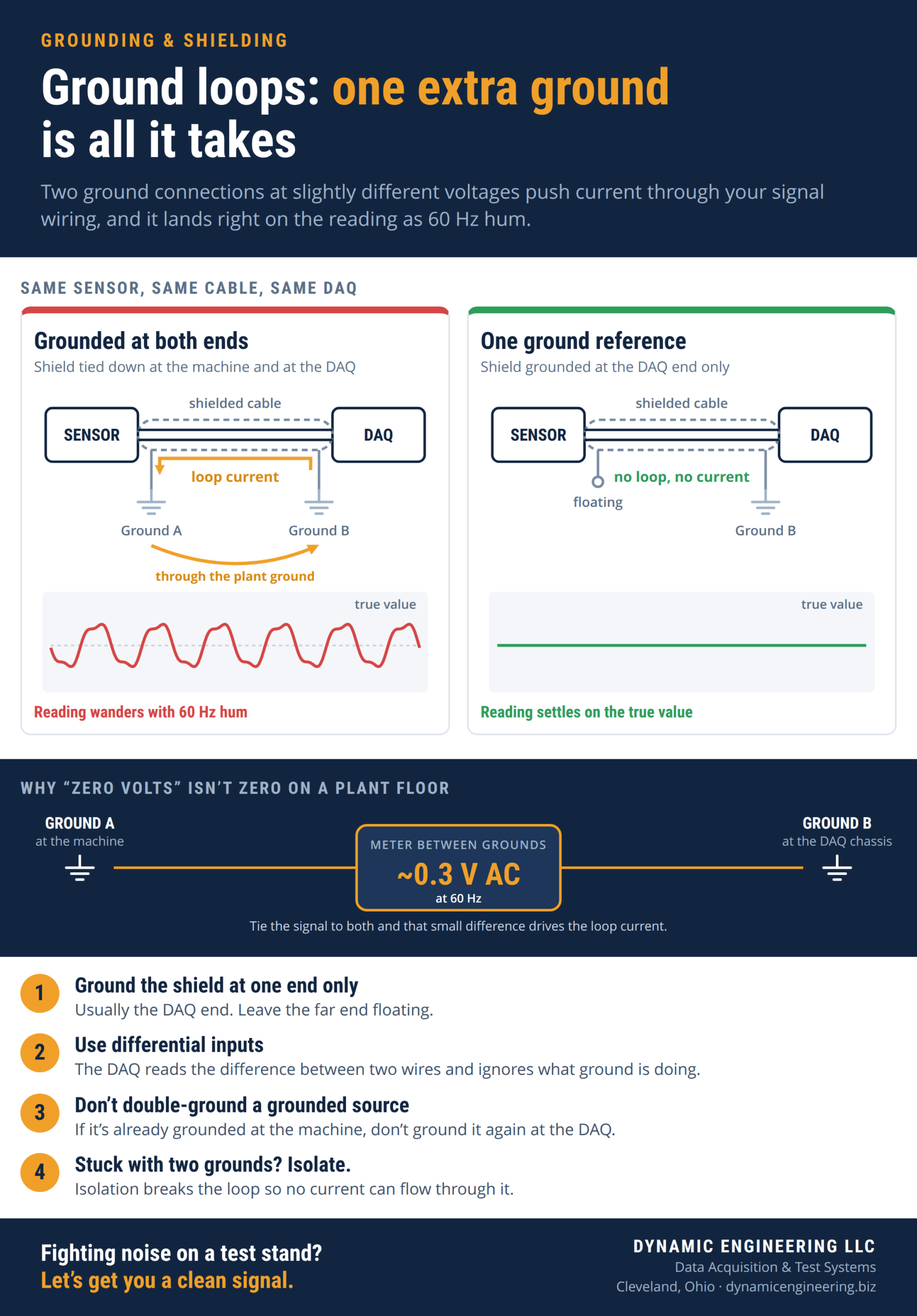
Ground is supposed to be one steady reference, zero volts everywhere. On a real plant floor it isn’t. Tie your sensor to ground at the machine and again at the DAQ chassis, and those two grounds sit at slightly different voltages. That small difference pushes a current through your signal wiring. It rides right on top of the measurement, usually as 60 Hz hum, and now your reading wanders.
How to keep it from happening
The fix is to give the signal just one ground reference. Ground the cable shield at one end only, usually the DAQ end, and leave the other end floating. Use differential inputs so the DAQ reads the difference between two wires and ignores whatever the ground is doing. And when the source is already grounded out at the machine, don’t ground it again at the DAQ. If you truly can’t avoid two grounds, break the loop with isolation so no current can flow through it.
How to track one down
When you suspect a loop, start by lifting one ground and watching what the noise does. Pop the shield connection at one end, or switch the channel over to differential, and see if the hum drops. A meter between the two ground points will often show you the small AC voltage that’s driving the whole thing. Change one connection at a time so you know which one actually mattered. Once the ground loop is broken, the reading usually settles right down.
Why one bad ground is enough
It only takes a single extra ground path to start the current flowing. That’s what makes this maddening to chase. The sensor checks out, the wiring looks fine, and the noise is coming from a connection nobody thought about. A few minutes with a plan beats an afternoon of guessing.
If you’re fighting noise on a test stand or building one from scratch, our team at Dynamic Engineering sorts out grounding, shielding, and the whole measurement chain for clients around Cleveland and well beyond. Get in touch with us and we’ll help you get a clean signal.