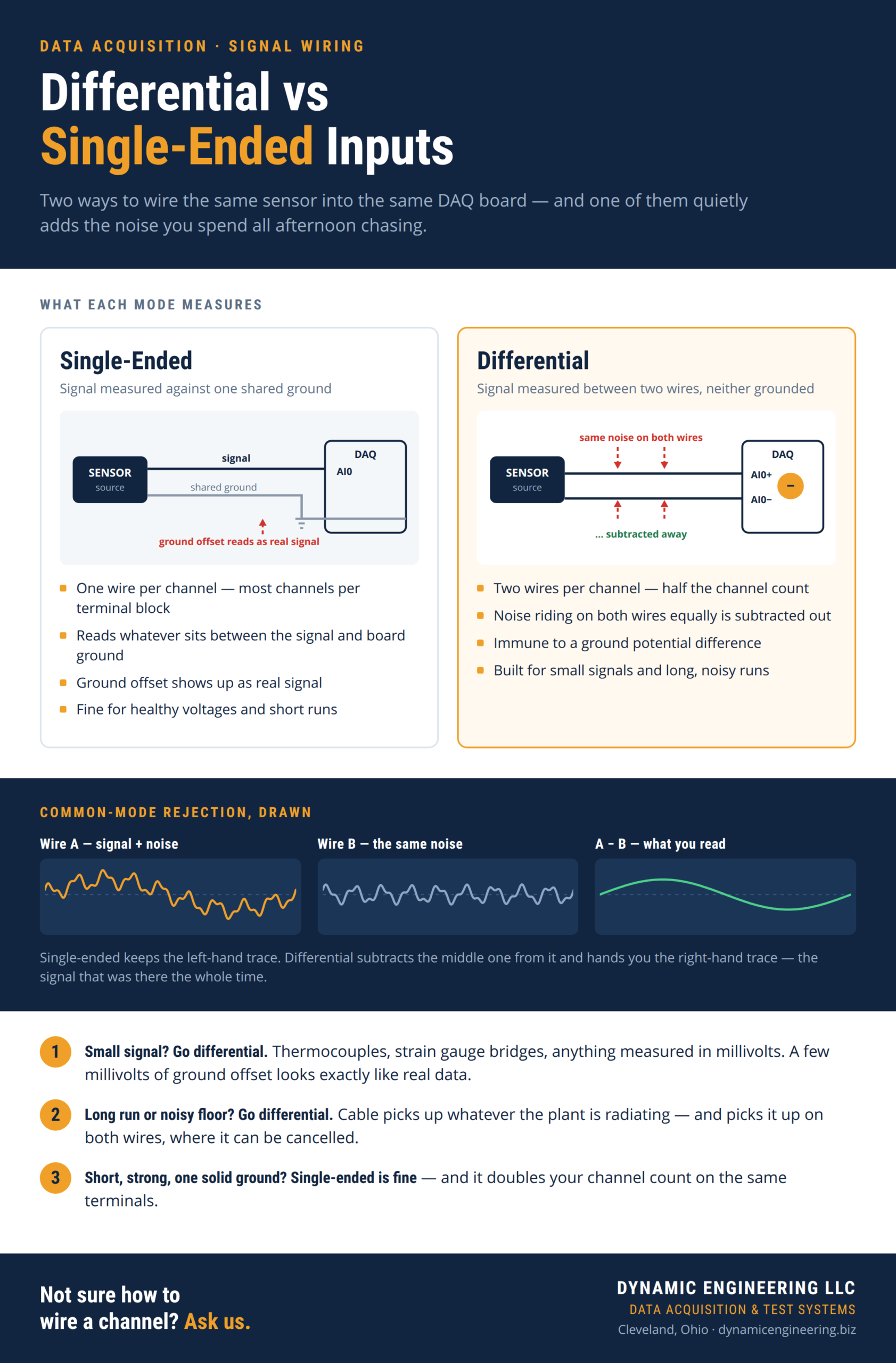
You wire a sensor into your DAQ, read the number, and it’s bouncing around more than it has any right to. A lot of the time the sensor isn’t the problem. It’s how the input got wired. Most data acquisition boards let you read a channel two ways, single-ended or differential, and picking the wrong one is an easy way to bury a good signal in noise. Differential vs single-ended inputs is the whole question, and it’s worth a minute before you land the wire.
What the two modes actually measure
Single-ended reads your signal against one shared ground on the board. One wire per channel, everything referenced back to the same point. It’s simple and it hands you the most channels for the money.
Differential reads the difference between two wires instead. Neither wire is tied to ground. Any noise that rides on both wires equally gets subtracted out and thrown away. That trick is called common-mode rejection, and it’s the whole reason differential wiring exists.
How to pick: differential vs single-ended inputs
Reach for differential when the signal is small, like a thermocouple or a strain gauge bridge. Same goes for long cable runs, a noisy plant floor, or any time the sensor’s ground and the DAQ’s ground don’t sit at the same potential. Those are the cases where single-ended will lie to you. A few millivolts of difference between two grounds looks exactly like real signal, and you’ll never know it’s there.
Single-ended is fine when the signal is a healthy voltage, the wiring is short, and everything already shares one solid ground. You also get twice the channel count out of the same terminals, so on a big station that adds up fast.
Not sure how to wire a channel?
Still weighing differential vs single-ended inputs? That’s the kind of thing our team sorts out every day. Dynamic Engineering is a data acquisition system integrator in the Cleveland, Ohio area, and we’re glad to help you get clean readings the first time. Reach us through our contact page, or read more about the people behind the work on our bio page.