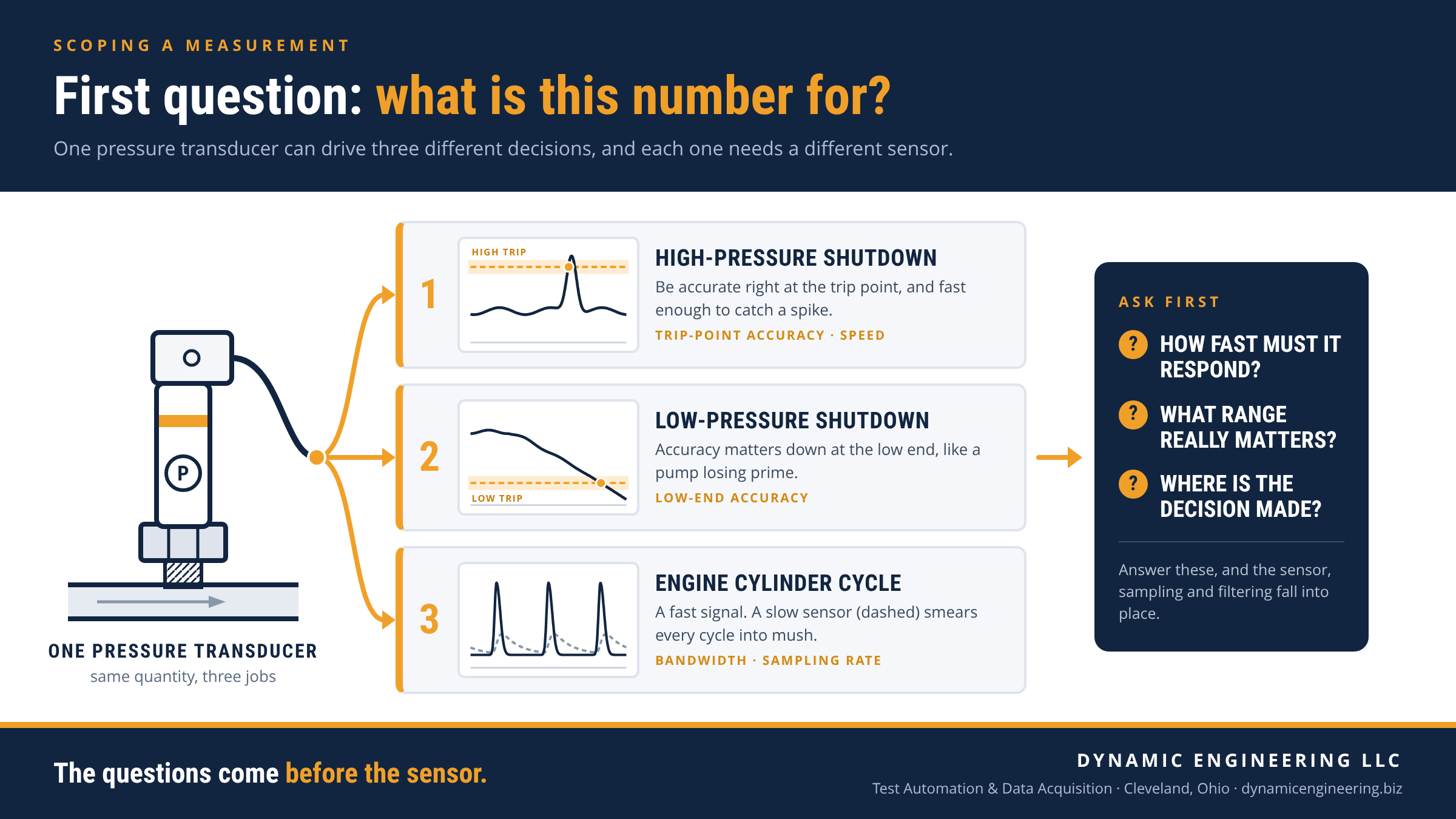

When someone asks us to measure something, the first thing we want to know isn’t which sensor to buy. It’s what the number is for. What decision does it drive, and how fast does it need to get there? The same reading can mean very different things depending on the job, and that changes how we build the whole system.
Take a pressure transducer. Before we pick one, we ask what it’s really doing.
Same pressure, different jobs
Is it there to shut the system down on high pressure? Then we care most about being accurate right at the trip point, and reacting fast enough to catch a spike before something lets go.
Is it watching for low pressure instead, like a pump losing prime or a line that’s lost its charge? Now the accuracy that matters lives down at the low end, and a slow leak can call for a different response than a sudden drop.
Or is it measuring the pressure cycle inside an engine cylinder? That’s a fast moving signal, and if we’re going to catch the shape of each cycle we need a transducer and a sampling rate that can keep up. A sensor that’s perfect for a slow tank reading would smear that waveform into mush.
Same quantity, pressure. Three completely different jobs, and three different sensors.
The questions come before the sensor
How fast does it need to respond? What’s the real range we care about? Where exactly does the decision get made? Those questions are the expert part, and they come before we pick anything. Get them right and the sensor, the sampling, the filtering, and the calculations all fall into place. Skip them and you find out late, usually after the stand is built.
That’s where being an electrical engineer, not just a programmer, pays off. As a LabVIEW consultant in Cleveland, we’re thinking about what the measurement is for, not only how to read it.
We help you through it
Most folks don’t come to us with all of this worked out, and that’s fine. Walking through those questions with you is part of the job. We help you figure out what the number is really for, then build around it.
If you want a LabVIEW consultant in Cleveland who starts with the right questions, get in touch with us. You can also read more about Joseph Zarycki and how we work. We’re a small shop, so we’re quick to respond, and our team is around whenever you need us.