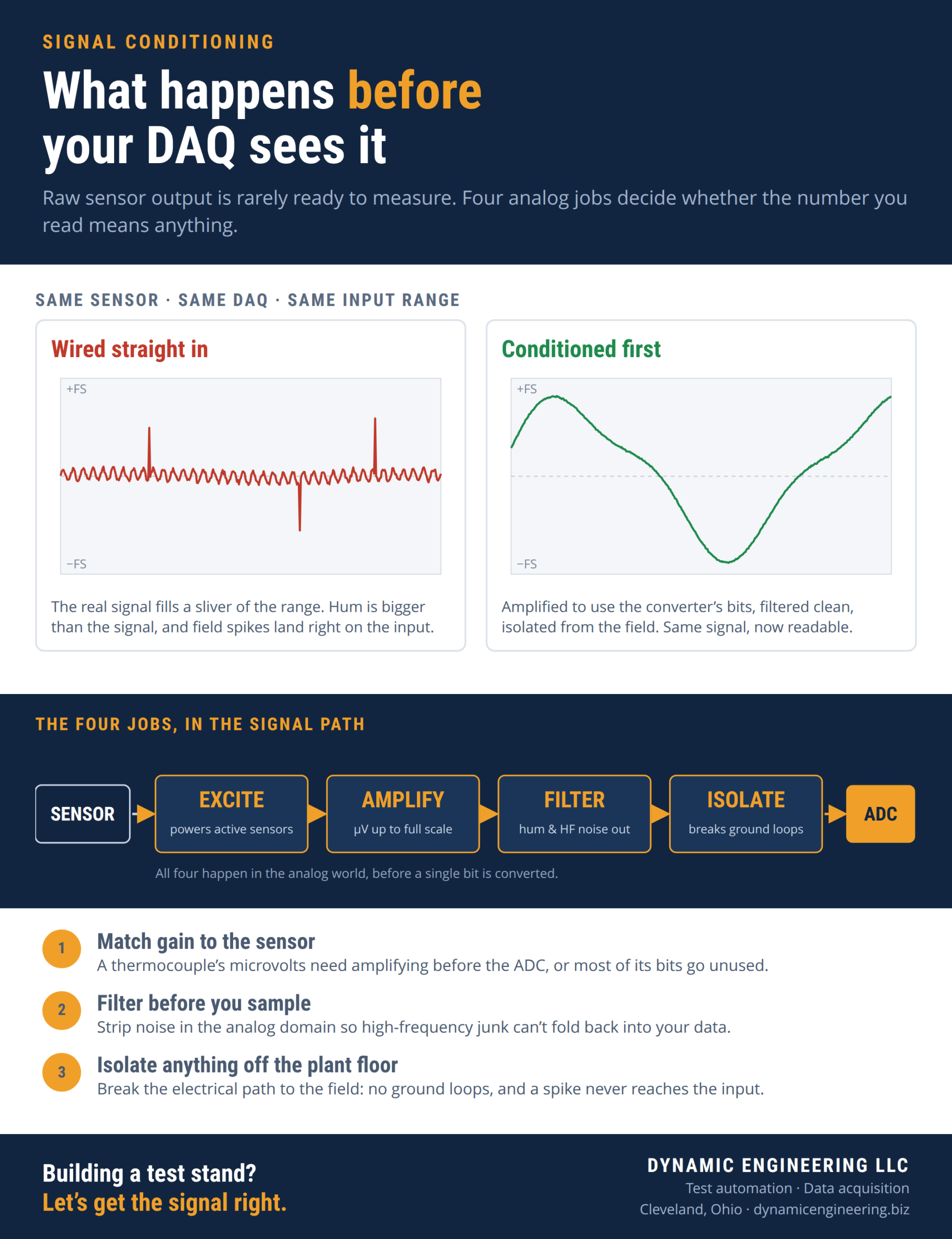
People picture a measurement as sensor plugs into DAQ, DAQ reads a number. In the real world there’s almost always a step in between, and it’s where a lot of measurement quality is won or lost. That step is signal conditioning.
The signal off a sensor is rarely ready
Raw sensor output is usually a poor match for the thing digitizing it. A thermocouple puts out microvolts, way down in the noise. A strain gauge puts out nothing at all until you feed it power. A signal coming off the plant floor can carry hum and voltage spikes that a bare analog input has no way to reject. Hand any of that straight to a DAQ and you’ll measure the mess right along with the signal.
What signal conditioning does to it
Signal conditioning is the handful of jobs that happen before the analog to digital step. Amplification boosts a tiny signal so it fills the input range and the converter’s bits actually get used. Filtering strips off noise and keeps high frequency junk from folding back into your data. Excitation supplies the current or voltage that active sensors like strain gauges and RTDs need to produce a reading at all. And isolation breaks the electrical path between the field wiring and your hardware, which kills ground loops and keeps a voltage spike from frying an input.
Do these well and the DAQ gets a clean, properly sized signal, and the numbers you read actually mean something. Skip them and you’re often measuring noise with great precision.
Picking the right conditioning for each sensor is a big part of a measurement that holds up. If you’re building a test stand or a data acquisition system and want it done right, our team at Dynamic Engineering has been at this in the Cleveland area since 2008. Give us a call.