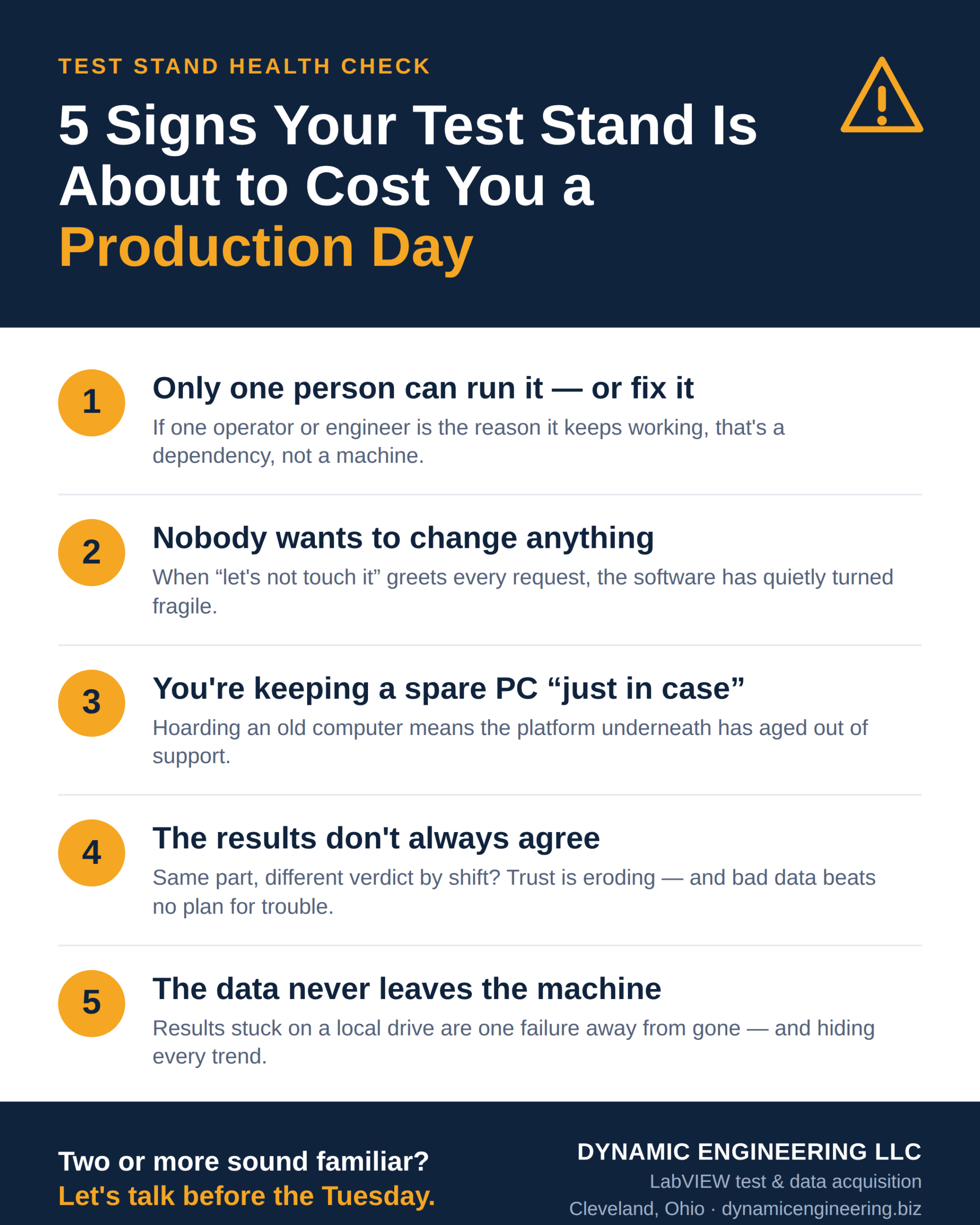
A test stand rarely fails on a schedule. It fails on a Tuesday, in the middle of a run, when you can least afford it. The good news is that most of them warn you first — and good test stand automation in Ohio starts with reading those warnings early. Here are five signs we’ve learned to take seriously.
1. Only one person can run it — or fix it
If a single operator or engineer is the reason the stand keeps working, you don’t have a machine, you have a dependency. The day they’re out sick or move on, the stand becomes a mystery.
2. Nobody wants to change anything
When a simple request — add a measurement, adjust a limit, test a new variant — gets met with “let’s not touch it,” the software has quietly become fragile. That fear is data.
3. You’re keeping a spare PC “just in case”
Hoarding an identical old computer because the stand won’t run on anything newer is a sign the platform underneath it has aged out. It works until the spare dies too.
4. The results don’t always agree with each other
If the same part can pass on one shift and fail on the next, or the stand argues with your gauges, trust is eroding — and untrustworthy test data is worse than no test data.
5. The data never leaves the machine
If results live on the stand’s hard drive and get copied off by hand, you’re one drive failure away from losing your quality record, and you’re missing the trends that data could be showing you.
None of this means scrap it
Every one of these is a signal to plan — while the stand is still running and you’re in control of the schedule, not reacting to an outage.
At Dynamic Engineering LLC, helping manufacturers around Cleveland and across Ohio get ahead of exactly these problems is a big part of what we do. If two or more of these sound familiar, it’s worth a conversation before the Tuesday. Reach out through our contact page.
Written by Joseph Zarycki, owner of Dynamic Engineering LLC — a Cleveland-area automation and controls firm specializing in LabVIEW, test stands, and data acquisition.