Tag: LabVIEW
-
cRIO vs cDAQ: When to Reach for Each
If you’ve ever spec’d out a National Instruments system, you’ve hit this fork in the road. Both platforms take the same C Series modules. Both measure the same signals. So why do they cost so differently, and which one does your job actually need? The short version A cDAQ needs a computer. It’s built to… Read more
-
Nigel Is a Fast Draftsman, Not an Engineer
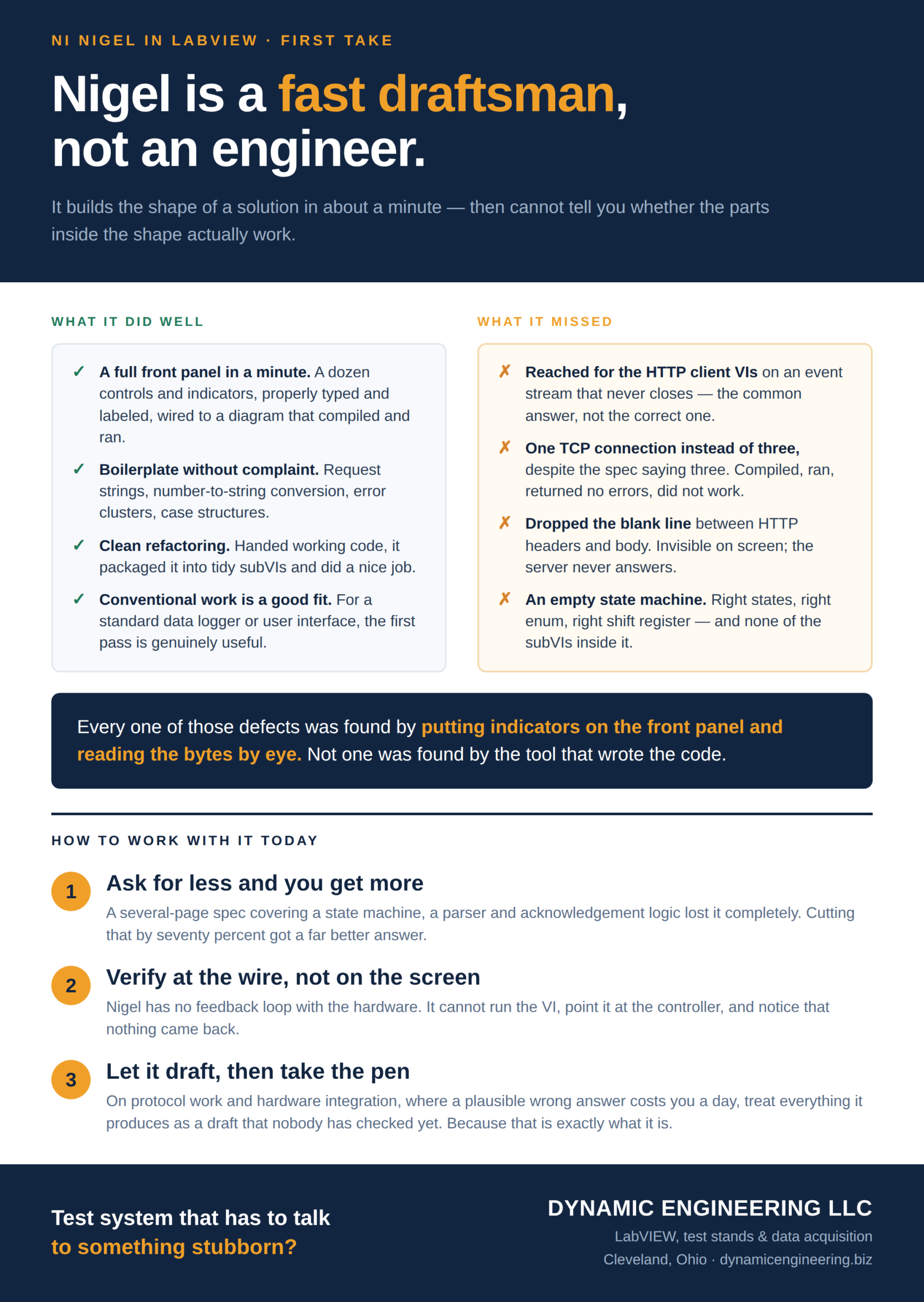
NI Nigel writes LabVIEW code fast, but it cannot test it. An honest first take after using NI Nigel on a real HTTPS controller project. Read more
-
Scaling a Test Lab: From One Working Bench to Many Identical Stations
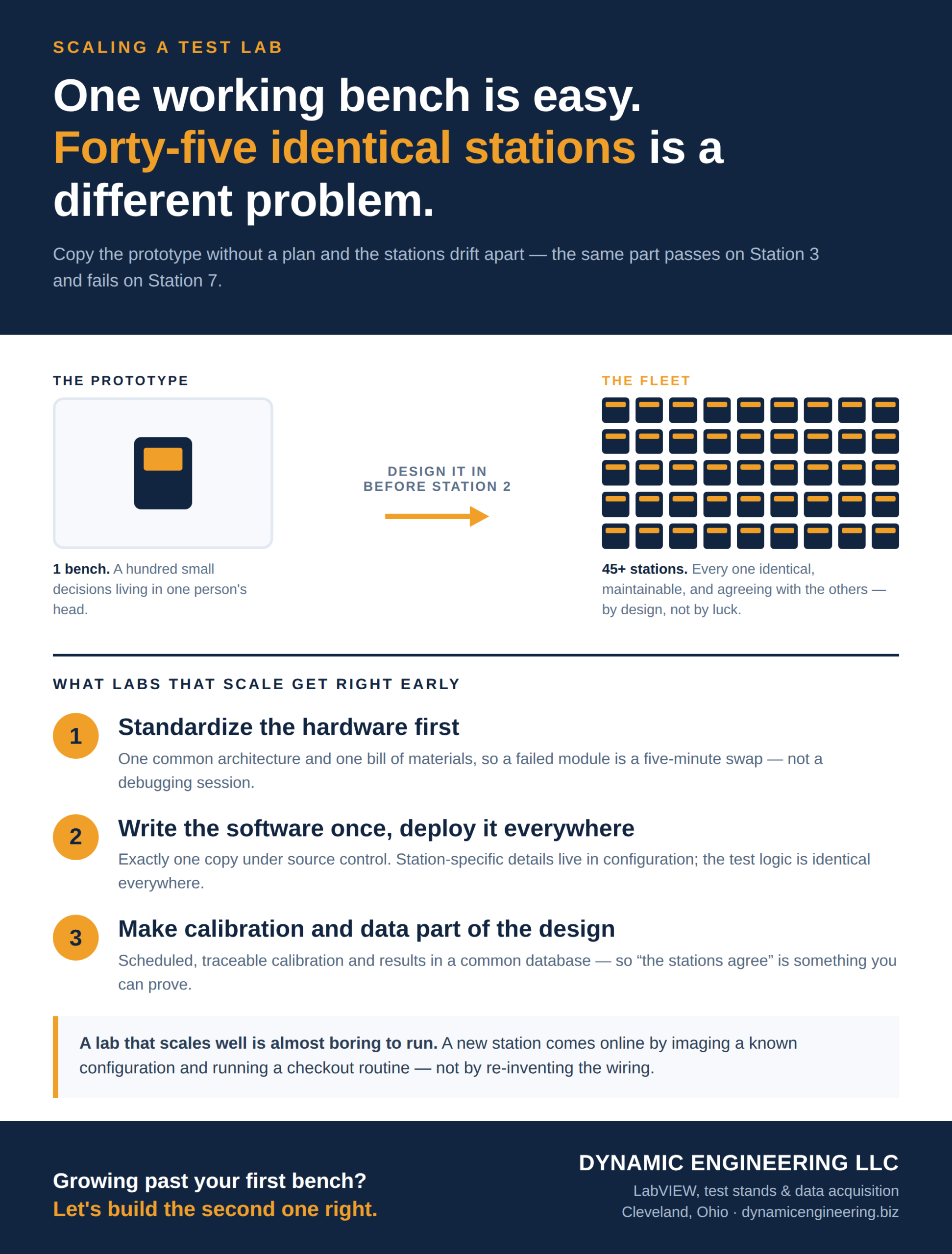
The first bench is the easy part. An engineer on your team builds a proof-of-concept test rig on a workbench in the corner. It reads the right sensors, drives the part through its sequence, and spits out a pass or fail. Everyone is happy. Then production planning does the math on takt time and volume,… Read more
-
When Human Inspectors Can’t Keep Up: A Quick Primer on Automated Visual Inspection
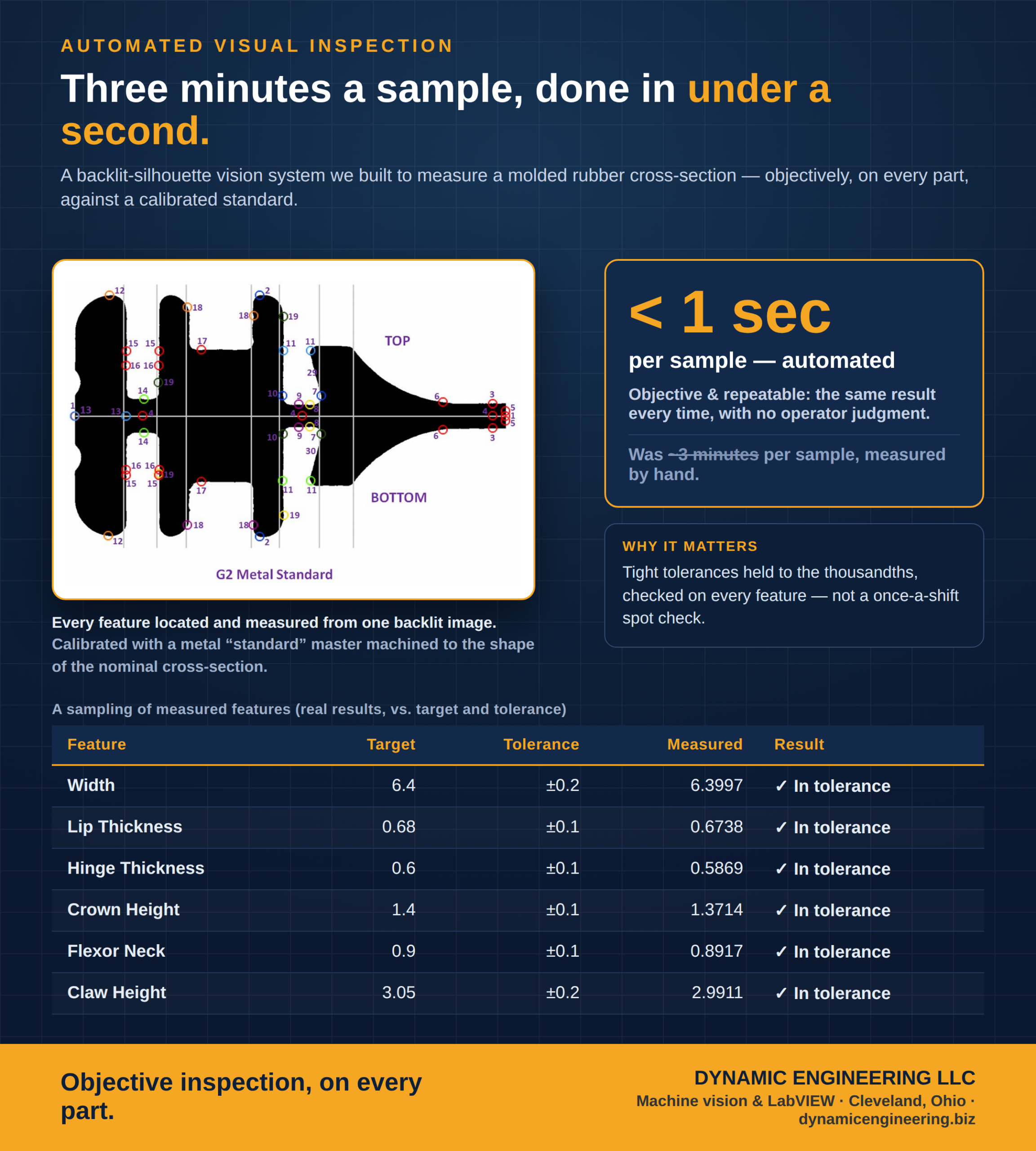
Visual inspection is one of the first things to break as a line speeds up. A skilled inspector can catch a lot, but people blink, tire, disagree with each other, and can only look at so many parts per minute. When throughput climbs or a defect absolutely cannot ship, “have someone watch for it” stops… Read more
-
Five Signs Your Test Stand Is About to Cost You a Production Day
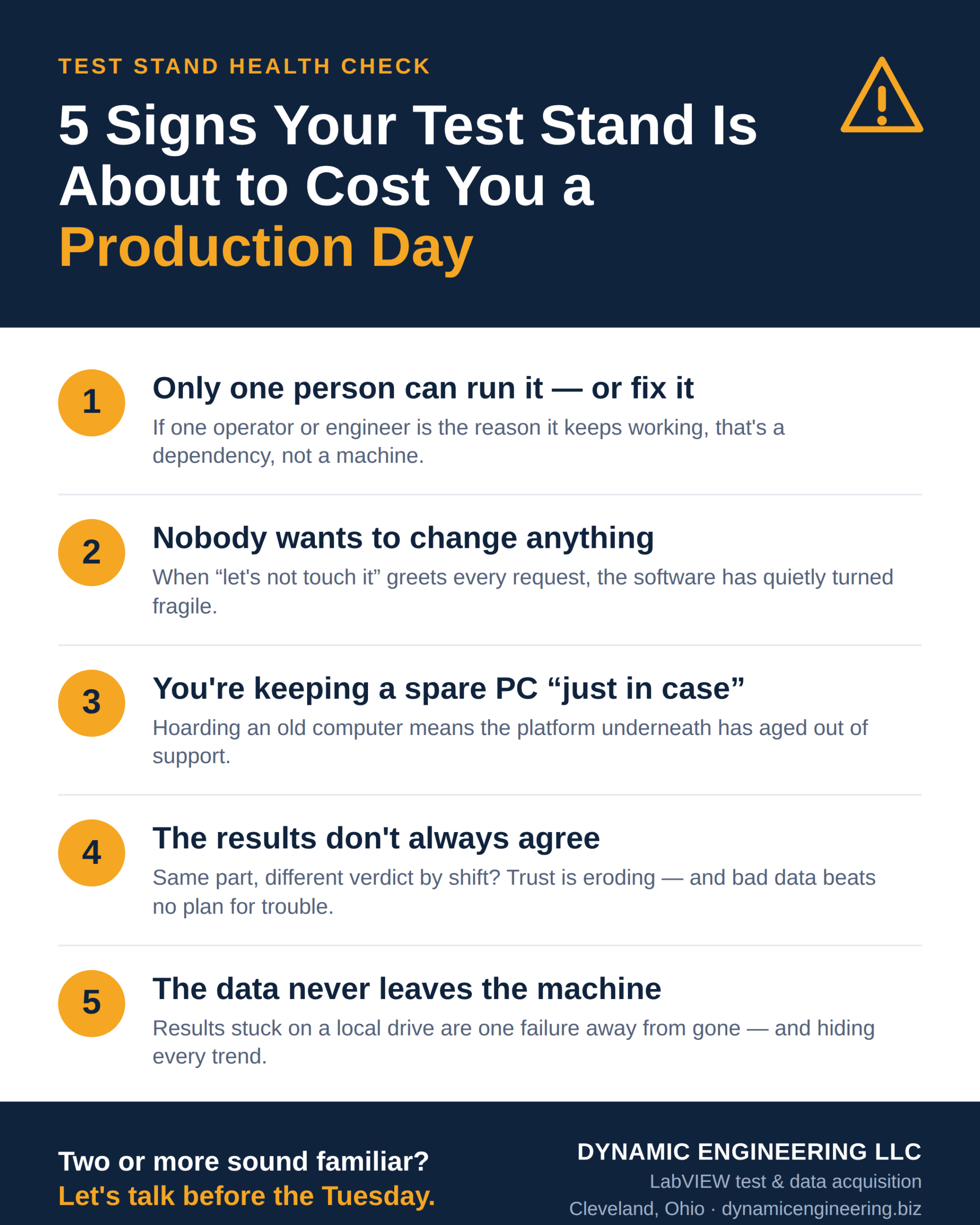
A test stand rarely fails on a schedule. It fails on a Tuesday, in the middle of a run, when you can least afford it. The good news is that most of them warn you first — and good test stand automation in Ohio starts with reading those warnings early. Here are five signs we’ve… Read more
-
What a Data Acquisition System Actually Does — and When Off-the-Shelf Isn’t Enough
Most manufacturing and product-development teams eventually reach a point where the measurements they care about outgrow a handful of gauges and a spreadsheet. That’s usually the moment someone raises the idea of a custom data acquisition system — and it’s worth being clear about what that actually means before you spend money on one. A… Read more
-
When the Auditor Asks for One Test Record, Can You Find It in Five Minutes?
Picture the afternoon a big customer schedules an audit. The email lands, and the first worry usually isn’t whether the parts passed. It’s whether anybody can actually put their hands on the proof. Then comes the quiet scramble: someone walking the floor with a USB stick, copying folders off test stands, squinting at file names… Read more
-
Fast to the Target, Steady at the Center: Two-Loop Flow Control on a Water Heater Test Stand
On a water-heater test, the flow rate going into the unit is the whole ballgame. The test standard specifies it to a tight tolerance, and if the flow isn’t sitting in that band, the run doesn’t count, no matter how good the rest of your instrumentation is. That puts the flow controller in an awkward… Read more
-
When Manual Testing Can’t Keep Up: Moving From Spreadsheets to Automated Test Stands
There’s a moment a lot of manufacturing and product-development teams hit without seeing it coming. Production ramps, a new variant gets added, or a customer asks for full traceability, and suddenly the way you’ve always tested, an operator with a handheld meter, a clipboard, and a shared spreadsheet, can’t keep pace. The line is faster… Read more
-
Your Test Stand Can’t Hear the ECU: Integrating CAN Bus Data into Automated Testing
Here’s a scene that plays out in a lot of test labs. The test stand itself works fine — thermocouples, pressure transducers, flow meters, all logging cleanly. But the unit under test isn’t just a mechanical device anymore. It has a controller on board, and the most interesting numbers — commanded operating point, internal temperatures,… Read more