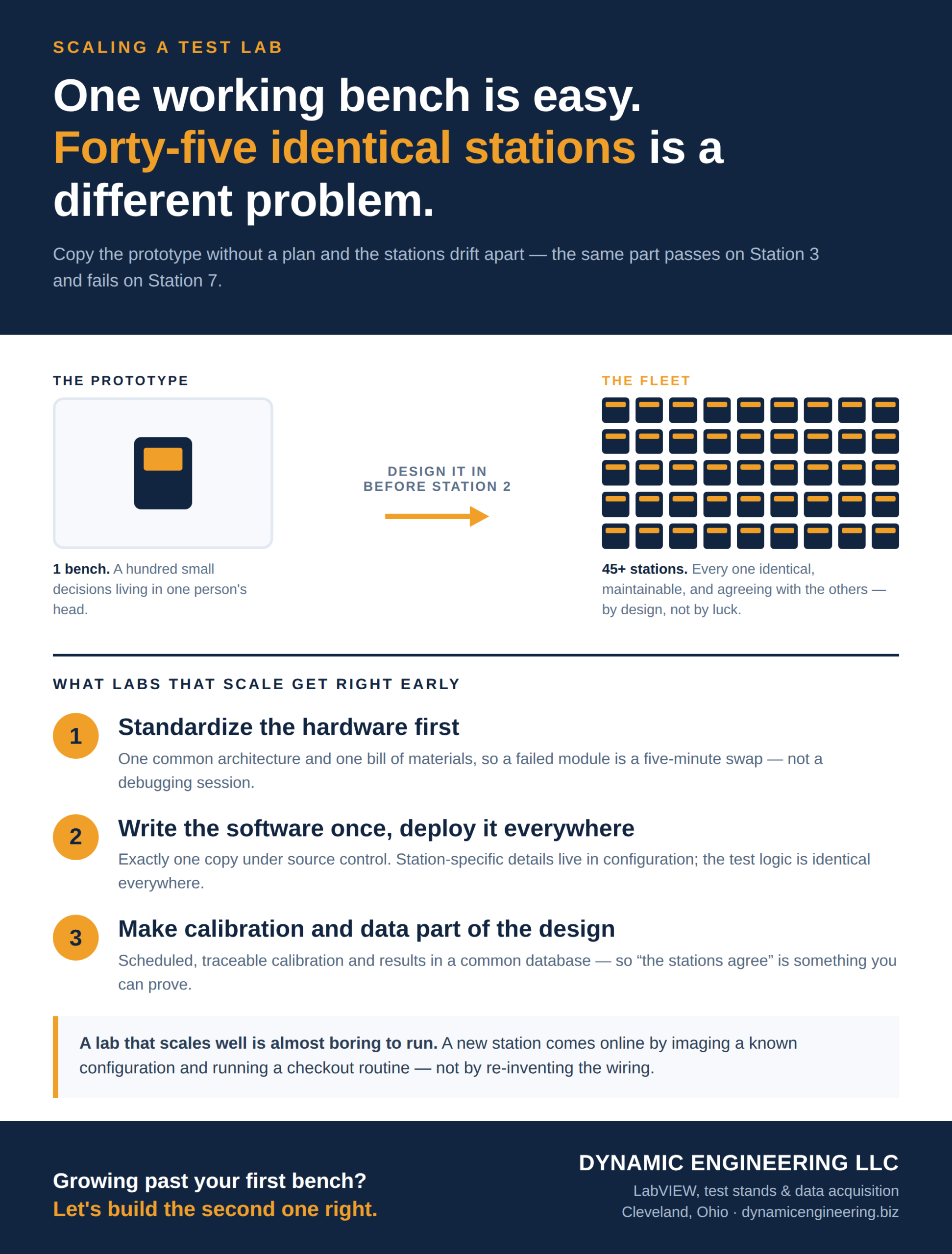
The first bench is the easy part.
An engineer on your team builds a proof-of-concept test rig on a workbench in the corner. It reads the right sensors, drives the part through its sequence, and spits out a pass or fail. Everyone is happy. Then production planning does the math on takt time and volume, and the request lands on your desk: we need eight of those. Or twenty. Or, in one lab we helped build, more than forty-five.
That is the moment a lot of test programs quietly go sideways. The problem is almost never the measurement itself — it is that a clever one-off bench and a fleet of identical, trustworthy stations are two completely different engineering problems. As a data acquisition system integrator in Cleveland, this is one of the most common calls our team gets, and it usually arrives after the first attempt to “just copy the bench” has already gone over budget.
Why copying the bench doesn’t scale
When you have one station, a hundred small decisions can stay in one person’s head. Which channel is wired to which sensor. The exact firmware on the DAQ module. The spreadsheet with the calibration offsets. The one setting someone tweaked on a Tuesday to make a stubborn fixture behave.
Copy that bench ten times and every one of those undocumented decisions becomes a way for the stations to disagree with each other. Now the same part passes on Station 3 and fails on Station 7, and nobody can say why. Operators lose trust in the whole line. Quality opens an investigation. And the “savings” from cloning the prototype evaporate into weeks of firefighting.
The stations drift apart for predictable reasons: hardware sourced piecemeal instead of standardized, code that lives on each machine’s desktop instead of in one controlled place, calibration handled by memory rather than by process, and test data trapped on local drives where no one can compare station to station. Scaling a lab well means designing every one of those out before you build the second unit — not after you’ve built the tenth.
Standardize the hardware before you standardize anything else
Repeatable stations start with a repeatable bill of materials. When our team designs a multi-station lab, we lock down a common hardware architecture first — typically built on modular NI (now part of Emerson) platforms like CompactDAQ or CompactRIO, chosen so that every station uses the same measurement modules, the same wiring map, and the same signal conditioning.
That standardization does real work. A CompactDAQ chassis gives you PC-controlled, modular measurements that are identical from station to station, while CompactRIO adds an embedded real-time controller and FPGA when a station needs deterministic timing or has to run without a host PC babysitting it. Picking the right one up front — and using it everywhere — means a module that fails on Station 12 is a five-minute swap with a known-good spare, not a debugging session. It also protects you from obsolescence: NI has published clear migration paths off its older data-acquisition families, and building a new lab on current, supported hardware keeps you off that treadmill for years.
Write the software once, deploy it everywhere
The second rule of a lab that scales: there is exactly one copy of the test software, and it lives under source control — not on twenty desktops where each has been “fixed” a little differently.
We build the LabVIEW application so that station-specific details — serial numbers, calibration constants, channel assignments — live in configuration that each station reads at startup, while the actual test logic is identical everywhere. Update the sequence once, and every station gets the same update. A station knows which one it is, but it runs the same code as all the others. This is the difference between a lab you can maintain with one engineer and a lab that needs a full-time babysitter per shift.
This discipline matters most the day something changes: a supplier revises a component, a spec tightens, a new variant comes down the line. In a well-built lab, that is one controlled change rolled out to every station. In a copy-the-bench lab, it is a scavenger hunt.
Make calibration and data part of the design, not an afterthought
Two things separate a real production test lab from a room full of benches. The first is calibration as a managed process — each station verified on a schedule against traceable standards, so “the stations agree with each other” is something you can prove to an auditor, not something you hope is still true. The second is getting the data off the machines. When every station streams its results into a common database or standardized files instead of a local spreadsheet, you can finally compare stations, spot a drifting fixture before it fails good parts, and answer the quality question that used to take a day of digging.
We’ve built this pattern into labs across very different industries — a lab of more than forty-five stations testing water heaters, certification stations for ENERGY STAR appliance testing, and inspection and end-of-line systems running across multiple plants. The products could not be more different, but the scaling problem is always the same shape: make the stations identical, make the software one thing, and make the data visible.
What this looks like when it’s done right
A lab that scales well is almost boring to run. A new station comes online by imaging a known configuration and running a checkout routine, not by re-inventing the wiring. An operator moving from one station to another sees the same screen. When a result looks wrong, the engineer looks at data from all the stations at once instead of walking the floor. And when the auditor, the customer, or your own quality team asks whether every station is measuring the same way, the answer is documented rather than assumed.
Getting there is a design decision you make early — ideally before the second station exists. Retrofitting consistency onto a room full of mismatched benches is possible, and we’ve done plenty of it, but it is always harder than building it in from the start.
Talk to a Cleveland test-lab team before you build the second station
If you’re staring at a working prototype bench and a production volume that says you need many more, that gap is exactly the work our team does. Dynamic Engineering LLC has spent since 2008 designing LabVIEW and data-acquisition test systems that stay identical, maintainable, and trustworthy as they scale from one bench to a full lab.
Learn more about our background on the About Joseph Zarycki page, and when you’re ready to talk through your own lab, get in touch with us. We’ll help you build the second station — and the forty-fifth — so they all agree.
Joseph “Joe” Zarycki is the founder of Dynamic Engineering LLC, a Cleveland-area automation and controls firm specializing in LabVIEW, test-stand automation, and data acquisition. He holds an MS and BS in Electrical Engineering from Case Western Reserve University and is an ISO 9001 and ISO 17025 certified lead internal auditor.