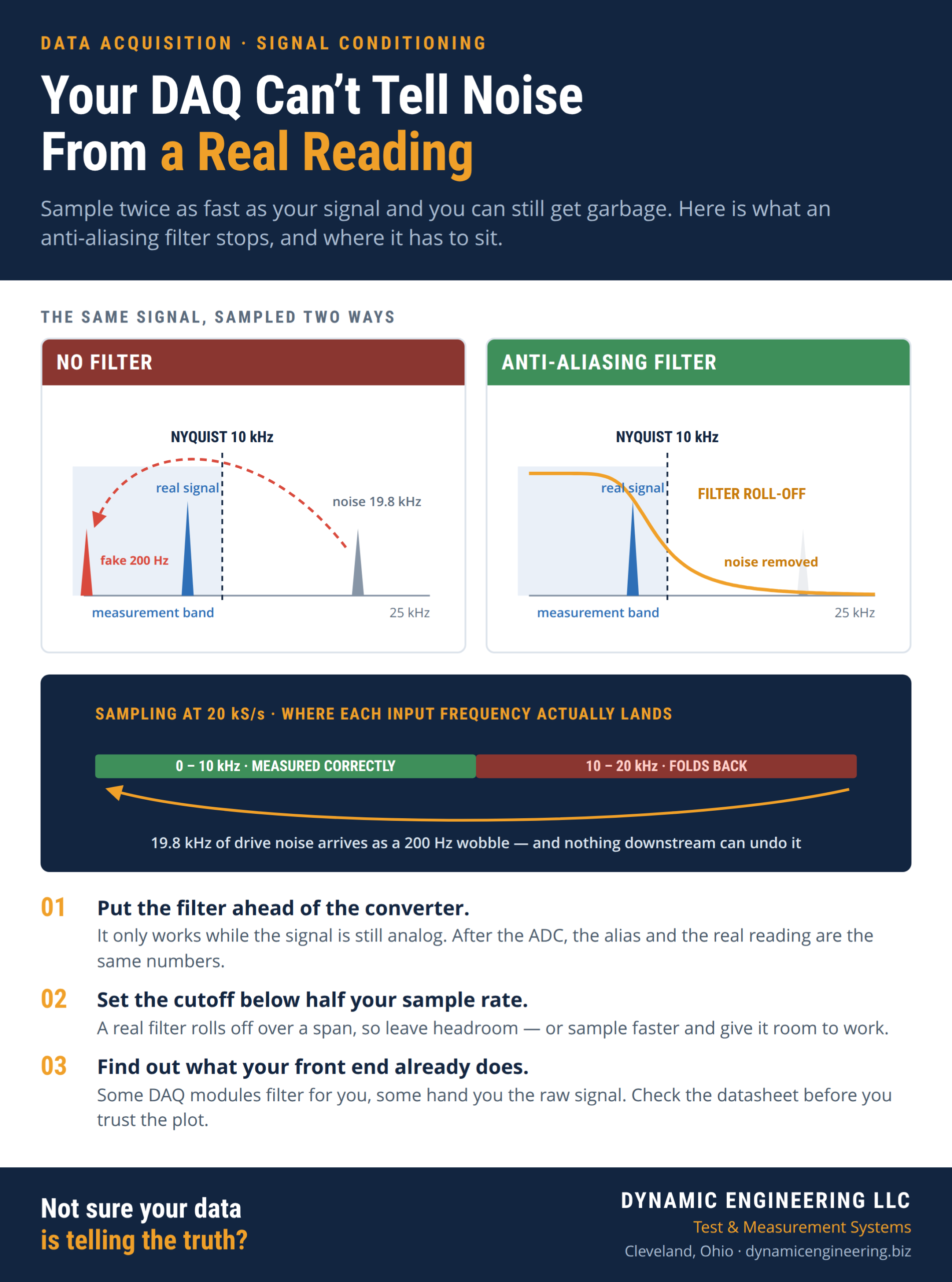
Sampling theory says you should sample at least twice as fast as the highest frequency in your signal. That’s a fine rule on paper. The problem is real signals carry stuff you didn’t plan for. Power line hum, motor noise, a variable speed drive kicking in across the shop, even a radio station down the road. That extra junk is exactly where an anti-aliasing filter earns its keep.
What aliasing actually does to your data
When a frequency higher than half your sample rate reaches the converter, it doesn’t just get ignored. It folds back down and lands somewhere inside your measurement band. So a fast 60 kHz spike can show up as a slow wobble at 200 Hz that looks totally real. Once it’s in the data you can’t tell it apart from a true reading. And no filter you run afterward in software will pull it back out. The bad number is already baked in.
Where the anti-aliasing filter sits
An anti-aliasing filter is just a low-pass filter, and it sits ahead of the ADC while the signal is still analog. It knocks down anything above the Nyquist frequency before the converter ever sees it. That’s the whole idea. Clean the signal while you still can, because the moment it’s sampled it’s too late.
Some DAQ hardware builds this in and some leaves it to you. If you’re grabbing fast transients or working near noisy gear, it’s worth knowing what your front end really does before you trust the plot.
Not sure your data is telling the truth?
If you’re putting together a measurement or test system and want it done right, our team at Dynamic Engineering can help. We’ve built data acquisition and test systems for manufacturers around the Cleveland area since 2008. Get in touch and let’s talk it through.