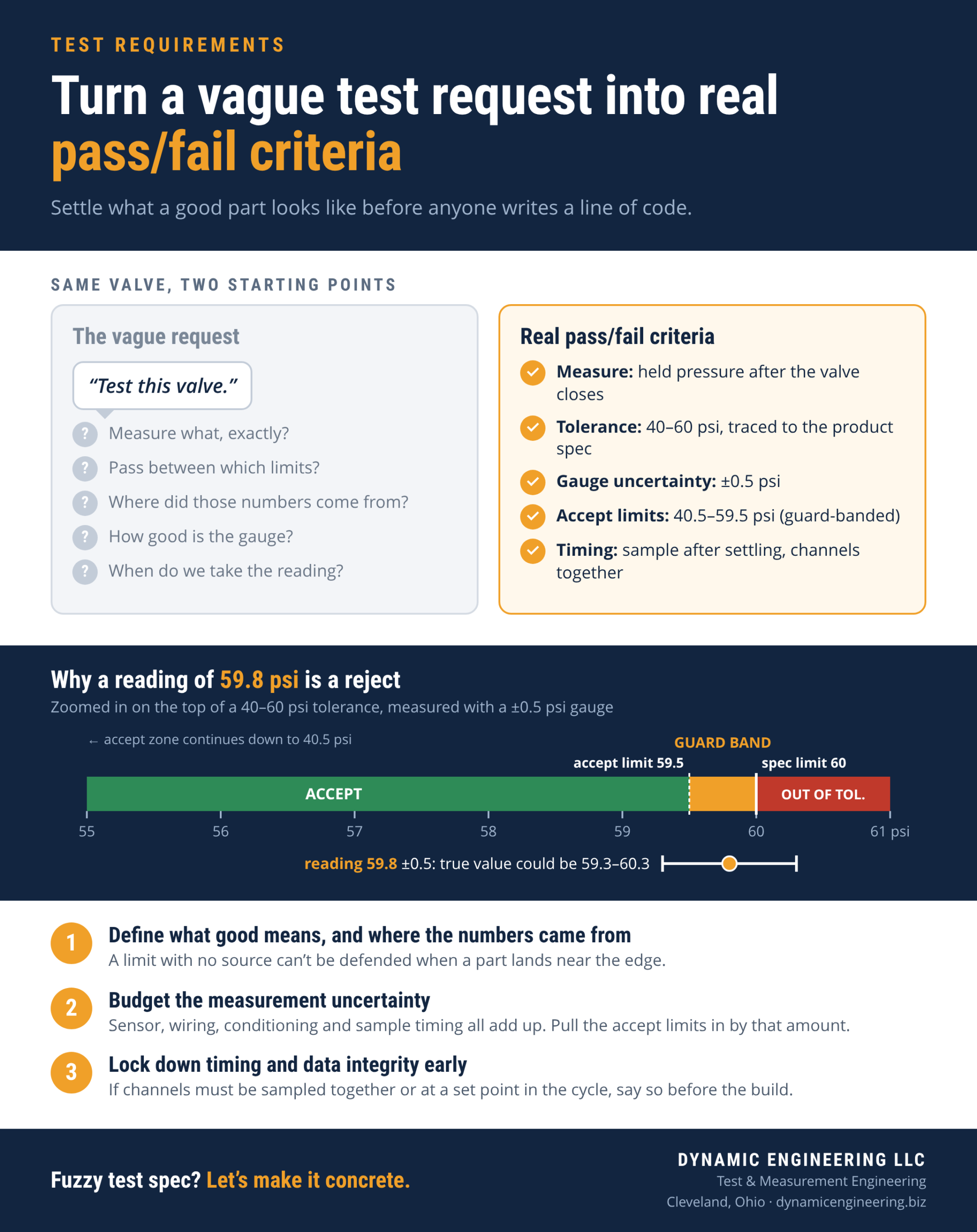

The test projects that cause the most grief usually don’t have a code problem. The snag is nobody nailed down what a good part looks like before the build started. Someone says test this valve, everybody nods, and it sounds simple. Then a few weeks in somebody asks what actually counts as a pass, and the room goes quiet. We’d rather sort out the pass/fail criteria on day one.
Start with what good actually means
The point of a test stand isn’t to collect numbers. It’s to make a correct pass or fail call on a real part, over and over. So we work out what the part has to do and how you’d know it did it. What are you measuring, what’s the acceptable range, and what happens at the edges. If the spec says a pressure holds between 40 and 60 psi, we want to know where those numbers came from and what a reading of 59.8 really means for the product.
Pin down the measurement, not just the limit
A limit on paper is only half of good pass/fail criteria. Every measurement carries some uncertainty, from the sensor, the wiring, the conditioning, and when you sample. If your gauge is good to plus or minus half a psi and your pass limit is exactly 60, you’ll pass parts that are really sitting at 60.4. That’s what a guard band is for. You pull the accept limit in from the true tolerance by enough to cover your measurement uncertainty, so a marginal part doesn’t slip through. How far you pull it in is an engineering call, the kind of detail that separates a stand that just runs from one you can trust.
Timing and data integrity count too
When you measure matters as much as what you measure. If a reading has to land at a certain point in a cycle, or two channels have to be sampled together, loose timing will quietly corrupt the result and nobody notices until a good part fails or a bad one ships. We think through the timing and the data path early, because by the time it shows up on the floor it’s expensive.
Why an engineer, not just a coder
We’re electrical engineers first, not just programmers, so we’re thinking about what the measurement means and why it’s needed, not only how to write the loop. We ask the questions that turn a fuzzy ask into a solid requirement. And as a smaller shop we stay close to the work and quick to answer, with support on hand around the clock when a line can’t wait.
If the pass/fail criteria on your test project are still fuzzy at the edges, our team can help you make it concrete. Get in touch with us and tell us what you’re measuring. You can also read more about Joseph Zarycki, our lead instrumentation engineer, based in the Cleveland area.