
A reading can be dead accurate and still point you the wrong way if it landed at the wrong instant. The value is only half of a measurement. When you took it is the other half, and in a test system data timing is easy to get wrong without noticing.
A number without a time is only half a measurement
When you log a temperature, a pressure, or a force, the value by itself doesn’t tell you much. You need to know when it happened so you can line it up with everything else. If a part fails, you want to see what the current, the vibration, and the temperature were all doing at that one moment. That only works if every channel agrees on what that moment was.
Where data timing quietly goes wrong
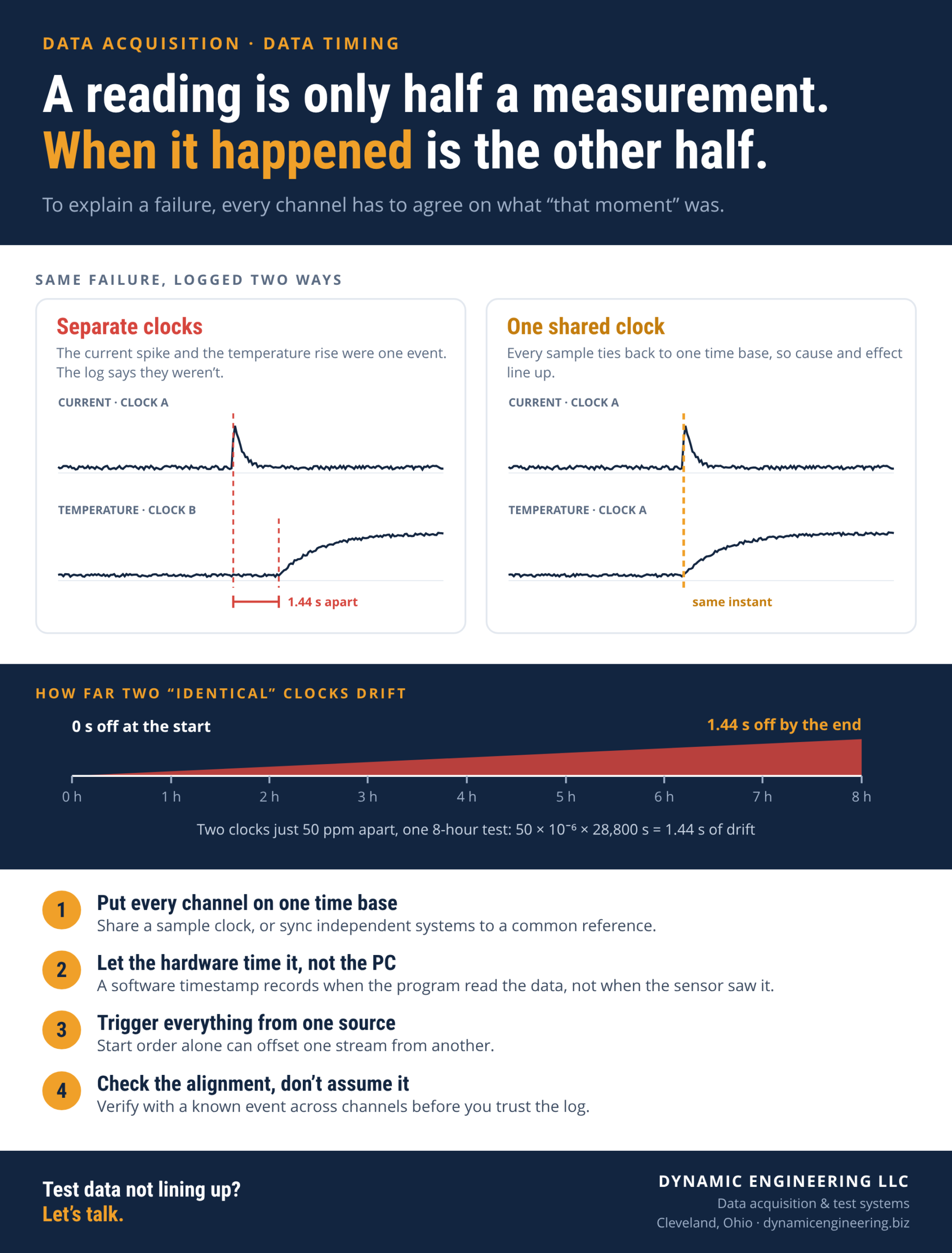
Trouble shows up when different measurements run on different clocks. Two devices sampling at the same rate will still drift apart over a long run, so a fault that lines up at the start is smeared by the end. Software timestamps are another trap. If you stamp data with the time your program happened to read it, you’re really recording when the PC got around to it, not when the sensor saw the event. And the order you start your tasks can offset one stream from another by a small startup delay.
How you keep the data honest
The fix is to put the measurements on a shared clock so every sample ties back to the same time base, and to let the hardware handle the timing instead of the PC. Trigger everything from one source. Where several independent systems have to agree, you line them up to a common reference and then check the alignment instead of assuming it. We’ve built systems where several separate data streams had to share one clock, and getting that right is what made the results trustworthy.
Why we design for data timing up front
This is where being an electrical engineer and not just a coder pays off. We think about what the data is for before we build the measurement, so the timing and the integrity get designed in from the start instead of patched in later. Dynamic Engineering is a data acquisition and test systems shop in the Cleveland area, and because we’re small we can move fast and answer when you need us. If your test data isn’t lining up the way it should, get in touch with us. You can also read more about the engineer behind the work.